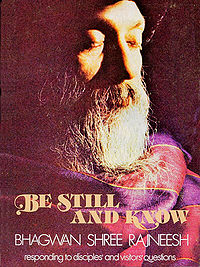
Be Still and Know
Discourses
Table of Contents
Always on the Rocks
Osho explains polar opposites—science and meditation—need no reconciliation; they are already one like day and night. Art sits between. He contrasts ego-driven Western painting with Zen's emptiness, and affirms Buddhahood is everyone's birthright; attraction to women is natural.
No Sin, No Virtue
Witnessing is mirror-like—neither joy nor sadness, beyond duality. Buddhas are inevitably misunderstood, speaking from beyond mind. Osho dismantles Jesus dying for humanity's sins as priestly invention, and traces religious intolerance to repressed doubt and ego rather than conviction.
No Question, No Answer
All questions are pointless; life is mystery to be lived, not solved. Wisdom is caught from a Master, not borrowed as knowledge. Personality must exist before being dropped—primitive innocence is not enlightenment. Stop fretting over clever or stupid.
You Are Ancient Pilgrims
Loving the Master as an equal surpasses respecting him as a saint. Prayer is wordless merging, not disguised desire. Diplomacy is sanctioned dishonesty. Jesus avoided teaching reincarnation openly because India's many-lives device had bred lethargy; one-life urgency suited his people.
Watch This! Stranger than Fiction
A child's rebellious no builds a needed ego; later the disciple learns yes to the Master. Three freedoms unfold—freedom-from, freedom-for, and freedom itself. Osho distinguishes true witnessing sharply from the alienated indifference many mistake for spiritual detachment.
Only Now
God is not a distant goal but pure presence available now—no path is needed. Consciousness, not moral character, is the real thing. The fear of death is actually fear of the ego dissolving; let it go and be reborn.
Thanks for the Compliment!
Existence is paradox, not logical contradiction—Aristotle's either/or fails before quantum reality and Einstein's relativity. Mahavira's sevenfold logic foreshadowed modern physics. A better world transcends good and bad. Osho's third-world-war talk is a device to awaken people now.
Just For Your Sake
Treating a group as more real than individuals is fascism; groups have minds, never souls. Heaven and hell are psychological states, not places. Loving even the Master's mispronunciations is how disciples embrace him totally—every quirk is a device.
He Died in Samadhi
Osho describes his father's death as enlightened—meditation made it a celebration, not a loss. Dadu's disciples Rajjab and Sundero merged into their Master out of love, not grief. The commune's felt unity is synchronized individuality, never a collective soul.
Me, Enlightened?
Osho's father's simple, ordinary life made enlightenment feel newly attainable. Stillness arises from seeing desire's futility, not hypnotic mantras. A suicidal disciple is urged toward meditation, not death. Hatred of homosexuals traces to repressed desire and fear of difference.