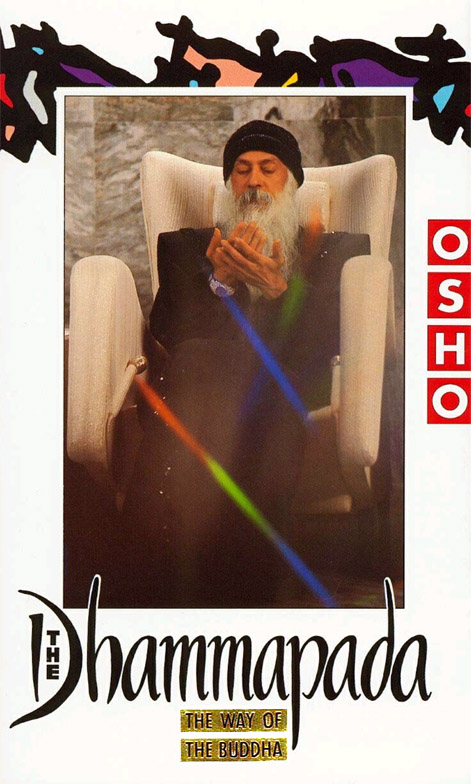
The Dhammapada: The Way of the Buddha, Vol 8
Discourses
Table of Contents
Discontent is divine
Discontent is divine. 'Everything arises and passes away. When you see this, you are above sorrow.' Discontent is divine: divine discontent—not with the world but with sleep. The worldly discontent wants more; the divine discontent wants truth. When you see impermanence, discontent transforms into the search.
The who behind all who's
The who behind all who's. Behind all your roles—who are you? The who behind all who's: you're a father, a worker, a citizen—but who is behind all these? The Buddha asks you to find the one who plays all roles. Not the mask but the face behind it. The eternal witness.
Freedom has to be earned
Freedom has to be earned. Freedom is not given—it's earned through awareness. Freedom has to be earned: existence gives you the potential, not the actuality. Freedom must be earned through meditation, awareness, understanding. The slave of the mind must work to become free. No one liberates you—you liberate yourself.
A madman's guide
A madman's guide. The Buddha's teaching seems mad to the worldly. A madman's guide: the Buddha is mad by the world's standards—he says the world is illusion, the ego is false, desire is suffering. The world calls this madness; the sage calls it sanity. The Dhammapada is a madman's guide to reality.
Be in the world and be holy
Be in the world and be holy. Not renunciation but transformation. Be in the world and be holy: the Buddha doesn't say leave the world—he says transform your relationship to it. The lotus blooms in mud. Be in the world, not of it. Holiness is not escape—it's awareness in the midst of life.
I call a spade a spade
I call a spade a spade. The master speaks directly—no euphemisms. I call a spade a spade: Osho doesn't sweeten the truth. If the ego is the problem, he says so. If religion is dead, he says so. The Dhammapada is direct—it cuts like a sword. Don't look for comfort in the Buddha's words—look for truth.
You have slept long enough
You have slept long enough. 'The followers of the awakened awake, and day and night they watch and meditate upon their master.' You have slept long enough: the Buddha's alarm—wake up! Not from physical sleep but from the sleep of unconsciousness. Centuries of sleep—enough. The Dhammapada is the wake-up call.
Out of chaos stars are born
Out of chaos stars are born. Chaos is the womb of creation. Out of chaos stars are born: when the old structure falls, don't despair—that's the chaos before creation. Stars are born from chaos—so is enlightenment. The ego's chaos is the prelude to the soul's birth. Embrace chaos—it's labor.
Sannyas is for sannyas' sake
Sannyas is for sannyas' sake. Not a means to an end—an end in itself. Sannyas is for sannyas' sake: sannyas is not to achieve something—it's a statement of being. Like art for art's sake—sannyas is the celebration of the seeker. Don't use sannyas—be sannyas. The Dhammapada: the path is the goal.
Towards a new humanity
Towards a new humanity. The Dhammapada points to a new kind of human. Towards a new humanity: the old human was divided—body against soul, mind against heart. The new human is whole. The Buddha's teaching is not for the old man—it's for the new. The Dhammapada is the blueprint.
The psychology of egolessness
The psychology of egolessness. Not a psychology of the ego but of its absence. The psychology of egolessness: Buddha created a psychology that doesn't study the ego but its dissolution. How does the ego form? How does it dissolve? The Dhammapada is the manual of ego psychology—and its transcendence.
Rivers don't exist
Rivers don't exist. The river is a name for flowing water—no entity called 'river.' Rivers don't exist: the river is not a thing—it's a process. So is the self—it's a process, not an entity. The Buddha's radical insight: you don't exist as a thing. You're a flow. The Dhammapada: see the flow, drop the thing.
All words are lies
All words are lies. Words can't capture truth—they lie. All words are lies: the Dhammapada's final paradox—the Buddha spoke for forty-five years, yet all words are lies. Truth can't be said. Words point—but they're not the thing. The Dhammapada is a lie that points to truth. Don't eat the finger—look at the moon.