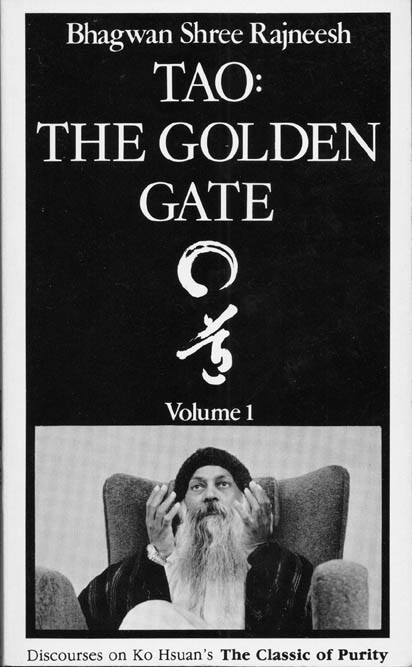
Tao: The Golden Gate, Vol 1
Discourses
Table of Contents
Just an empty passage
Just an empty passage. 'The supreme Tao is formless, yet it produces heaven and earth. The supreme Tao has no desires, yet the sun and moon revolve. The supreme Tao is nameless.' Just an empty passage: Tao is not a thing but a passage—empty, open. You can't possess it; you can only be it. Formless, desireless, nameless—it is the source of all forms.
Existence is God's expression
Existence is God's expression. 'About discipline and repression.' Discipline is awareness; repression is violence. Discipline transforms; repression distorts. Existence is God's expression: not God creating existence but existence IS God's expression. You can't separate the dancer from the dance. Discipline means living naturally; repression means living unnaturally.
Grow Real Roses
Grow Real Roses. 'What is the secret of remaining happy and married?' There is no secret—marriage is an unnatural institution. Grow real roses: plastic roses last forever but have no fragrance. Real roses wither but are alive. Don't seek permanence—seek aliveness. Love is a real rose—marriage is plastic.
Discover your own God
Discover your own God. 'What about people like Brecht who reject religion but shine with creative love?' Religion is not the only path—creativity can also be a door. Discover your own God: don't borrow God from scriptures. Brecht rejected religion but his creativity was his religion. God is not in churches—God is in authentic expression.
A World Inside You
A World Inside You. 'Tao manifests as pure and turbid, movement and stillness. Heaven is pure, earth is turbid. Masculine is active, feminine is passive.' A world inside you: the macrocosm is in the microcosm. Your inner heaven and earth, masculine and feminine, must unite. When they balance within, you find the Tao.
The Taste of Eternity
The Taste of Eternity. 'How to meditate without using the mind?' Meditation is beyond mind. You can't meditate with the mind—you meditate when the mind stops. The taste of eternity: can't be described, only tasted. Like salt in water—it's there but invisible. Eternity is in every moment—you taste it when the mind is still.
Into the Open Sky
Into the Open Sky. 'Are children really so intelligent?' Yes—children are born intelligent; society makes them stupid. Into the open sky: the child's consciousness is the open sky—no walls, no boundaries. Education builds walls. The master destroys walls to restore the open sky. Children are Buddhas; adults are fallen Buddhas.
Now Here
Now Here. 'I am a judge—any chance of entering nirvana?' Nirvana is not a place you enter—it's a state you awaken to. Now here: nowhere becomes now here when you add a space. The judge judges; the awakened one accepts. Don't change your profession—change your consciousness. Nirvana is available to all.
Tao Takes Care
Tao Takes Care. 'When man transcends that which changes, abiding in purity and stillness, heaven and earth are united in him. The soul loves purity, but the mind is rebellious.' Tao takes care: when you stop trying to control, the Tao takes over. The mind loves stillness but desires draw it into activity. Govern your desires and the mind becomes still spontaneously.
Saying Yes to Life
Saying Yes to Life. 'Why can't I say yes to myself?' Because you've been taught to say no. Saying yes to life: the ultimate religious act is saying yes—to yourself, to existence, to everything. The ego is the no-sayer. When you say yes, the ego dissolves. Yes is the golden gate to the Tao.