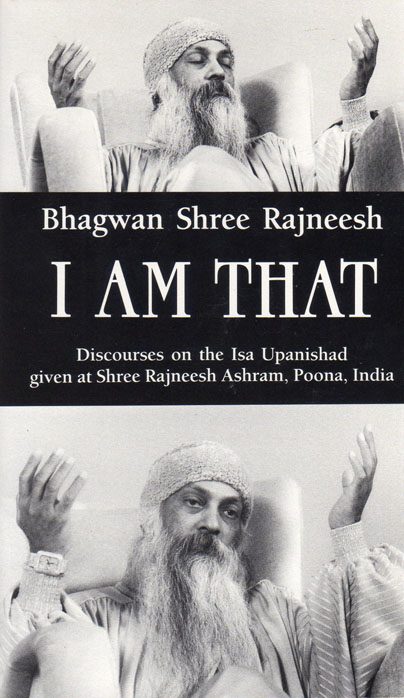
I Am That
Discourses
Table of Contents
Beyond the Changing
The Isha Upanishad: 'That is the whole. This is the whole. From wholeness emerges wholeness.' At the heart of the phenomenal world, within all changing forms, dwells the unchanging. Go beyond the changing, enjoy the inner, cease taking for yourself what to others are riches. Continuing to act in the world, one may aspire to be one hundred—thus free from binding action. Beyond the changing: wholeness remains.
Living in your own Light
God is not a person but a presence—like beauty, like joy. God means godliness. Buddha denied God's existence to emphasize quality over personality. Prayerfulness, not prayer. Temples and statues are nonsense. The religious man prays to a person above; the atheist denies even the experience. Both miss: God is an experience to be lived, not a person to be worshipped. Living in your own light: godliness is your own presence.
By Following Nobody Knows
By following nobody knows. Two discourses without jokes—Osho remedies with the chalk-behind-ear joke. Following is not the way: truth is discovered, not followed. The spring comes and grass grows by itself—but you must be silent to feel it. Following somebody else's path is imitation, not understanding. Each individual must find their own way. No joke in discourse doesn't mean no humor—existence itself is a cosmic joke.
Surrender is of the Heart
Man is a biocomputer but something more. Behaviorists study the unconscious man—naturally they find nothing transcendental. Buddha said all things are composite, no self—but he also pointed to the beyond. Psychology means 'science of the soul' but modern psychology isn't that yet. Meditation must become psychology's foundation. Surrender is of the heart, not the head. The transcendental exists as potential in the unconscious, as reality in the Buddha.
Bound in Deep Togetherness
The One Self never moves yet is too swift for the mind. Senses cannot reach it. It moves yet moves not; far yet near; within all and without all. He who sees everything as the Self withdraws from nothing. Bound in deep togetherness: the enlightened see all as Self—how could suffering continue? The Self is radiant, unbounded, untainted, invulnerable, pure. It has harmonized diversity throughout eternal time.
Absolute Love, Absolute Freedom
Absolute love, absolute freedom. The spring comes regardless, but you must be open to feel it. The wall between within and without is the mind—thoughts, desires, memories. Silence opens you; noise keeps you closed. The unmanifest is vaster than the manifest—it contains all future possibilities. Desires are antagonistic; choosing some leaves others nagging. Absolute love means no conditions; absolute freedom means no expectations. The grass grows by itself.
Each Moment -- Miracles!
Can an enlightened person be wrong? Krishnamurti says no master is needed—he's right from the peak but useless to those in the valley. The enlightened person speaks from where he is or from where you are. Krishnamurti considers only his space; I consider yours. Each moment—miracles! The enlightened can be right but useless. I speak from the dark valley to lead you to the peak. The journey is real for those who haven't arrived.
Knowing Nothing About Everything
Knowing nothing about everything. Proud to be a Polack? Pride is ego needing crutches—country, religion, culture are props. The ego enters from another door in new disguise. For sannyasins, dropping ego in all forms is the work. Three Polacks applied for 'Man Wanted For Rape.' Knowing nothing about everything: Socrates knew he knew nothing. The fool knows everything; the wise knows nothing. Polack jokes are not against Polacks but against the ego.
Both and More
Both and more. Into darkness go those who worship action alone; into greater darkness those who worship meditation. He who knows both together leaves death behind through action and gains immortality through meditation. Into darkness go those who idolize the absolute; into greater darkness those who dote on the relative. Both and more: truth is neither action nor inaction, neither absolute nor relative—it is beyond both. Wholeness includes all opposites.
The Eternal Religion
The eternal religion. Indians' diseases are not special—diseases come in all forms. I reject diseases, not you. You identify with your conditioning. Diseases existing for centuries become respectable. The eternal religion: not Hinduism, Christianity, Islam—but the search for truth. India's diseases: fatalism, poverty-worship, renunciation. I condemn the disease with compassion for the person. The physician who accepts your disease is your enemy. The eternal religion is individual inquiry.
No Mind At All
No mind at all. For socialists: freedom is the ultimate value, higher than equality. Men are unique, not equal. For Catholics: your religion is a disease. For seekers: the message is silence—but on radio, silence is conveyed through presence. No mind at all: not the mind that thinks but the no-mind that is. Freedom means being yourself, not fitting a pattern. Socialism forces sameness; meditation celebrates uniqueness. The potential seeker needs not a message but a transformation.
A Mystery to be Lived
A mystery to be lived. 'Push me, Osho! I'm on fire!' Crazy, baby, crazy—that's what I'm here for. The fire of the present burns past fears like a candle dispels ancient darkness. Fear comes from the past (dead); fire is now (alive). A mystery to be lived, not a problem to be solved. The jump into the unknown is scary and beautiful simultaneously. Everything becomes cuckoo—and that's exactly right. The unknown is not intellectual but existential.
Prayer Simply Happens
Prayer simply happens. 'The threshold of reality is veiled by golden light. Reveal it, O Lord.' 'For I myself am That!' Let my breath merge with cosmic breath. Prayer is not addressed to someone—it's a state of gratitude. Prayer simply happens when the heart opens. It's not doing but happening. 'O Agni, show us the right path'—the prayer of the Isha Upanishad is surrender to existence, not petition to a person. The golden light veils reality; devotion reveals it.
Without Women -- No Buddhas
Without women—no buddhas. Love is the hardest thing—it requires dropping the ego. Saints escaped to monasteries from fear of love, not love of God. Cowards worshipped as saints. Fear of love is fear of losing the ego. Beautiful women frightening? The fear is of surrender, of vulnerability. Without women no buddhas: woman is the path—love leads to meditation. Love and meditation are two ends of one bridge. The monk who renounces love renounces the only door to the divine.
Everybody has his Uniqueness
Everybody has his uniqueness. Socialism in the commune is not structural but the fragrance of meditation. Real socialism is revolution in individual consciousness, not society. Buddha's sangha was a commune—communication between heads, communion between hearts. When hearts open, a Buddhafield is created. Communism from 'commune,' not from Marx. No politics—just meditation's fragrance. Everybody has his uniqueness: equality is unpsychological. The commune celebrates uniqueness, not sameness.
It is Already the Best
It is already the best. Life is already perfect—improving it is the ego's disease. 'Ais dhammo sanantano'—this is the way things are. Trying to improve makes you helpless; doing nothing also fails. Emptiness seems dull because you're still expecting. It is already the best: wholeness from wholeness, wholeness remaining. Don't try to change—celebrate what is. The idea of improvement is the cause of misery. Perfection is not a goal but the nature of existence. The whole remains whole.