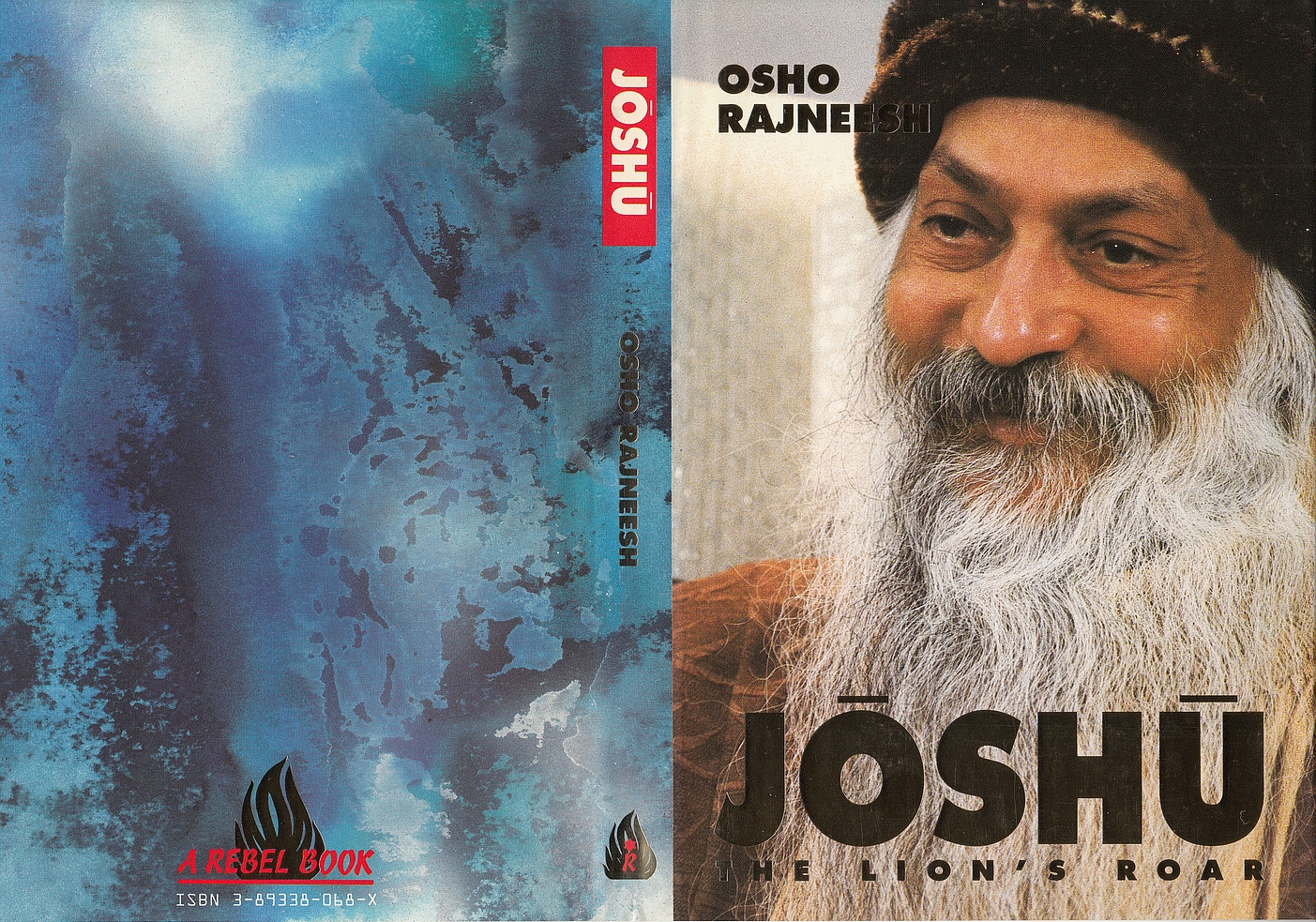
Joshu: The Lion's Roar
Discourses
Table of Contents
Joshu became enlightened without formal initiation—nobody's disciple. He met Nansen: 'Where have you come from?' Joshu: 'I only see the Tathagata lying down.' Nansen: 'Are you with or without a master?' Joshu: 'Early spring is cold—I'm glad you are well.' Nansen gave him special treatment. Joshu is the most loved Zen master—his working on disciples was soft, delicate, like a sculptor carving buddhas from stones. 'Where have you come from?' asks not your address but your original source.
Ruined and homeless
Ruined and homeless. Joshu's first satori at seventeen: 'Suddenly I was ruined and homeless.' The old personality, mind, cultivated identity—all shattered. But this is only half the experience—the other half (finding the real home) cannot be said. Joshu filled the kitchen with smoke, shouted 'Fire!' then said 'I won't open the door unless you say the right word.' Nansen silently passed the key through a window—the right word. The new brings its own language, its own home.
To know the timeless
To know the timeless. Joshu stayed with Nansen thirty years, then thirty more at Kuan-yin Temple. 'A hair's breadth of difference—and what happens?' 'Heaven and earth are far away.' 'And when there is NOT a hair's breadth of difference?' 'Heaven and earth are far away.' Lightning gods: Indra, Zeus—mysterious phenomena became gods out of fear and ignorance. Human aura radiates one inch around the body. The timeless is not about duration but about being beyond time entirely.
Go on digging
Go on digging. Joshu: 'I practiced zazen for thirty years. If you fail to grasp the Way, cut off my head and make it a ladle to draw urine with.' Dhyan (Sanskrit) → jhan (Pali) → ch'an (Chinese) → zen (Japanese). Dhyan means looking without thinking—your eyes become a mirror. The mirror never condemns or appreciates. 'I have nothing inside, and I seek for nothing outside.' Thousands seek Buddha, not one is a true man of Tao. Go on digging: the well is within.
An open sky of witnessing
An open sky of witnessing. 'When the universe is destroyed, Buddha nature will not be destroyed. What is this nature?' Joshu: 'The four elements and five components.' Those ARE the things destroyed—but Buddha nature IS them. Don't stay where Buddha is; pass quickly through where there is no Buddha. Don't bring up Buddhism for three thousand leagues! The monk: 'Then I won't go.' Joshu: 'Farewell!' Buddha nature is not separate from the universe—it IS the universe.
The ultimate here
The ultimate here. 'Have you been here before?' 'Yes.' 'Have a cup of tea.' 'Have you been here before?' 'No.' 'Have a cup of tea.' The prior asked why same for both. Joshu called 'Prior!' 'Yes?' 'Have a cup of tea!' Mind avoids the obvious because the obvious is already achieved. The master at the reception desk—no time wasted. The whole philosophy of Zen in a cup of tea. The ultimate here: enlightenment is not somewhere else—it's in the ordinary.
Eternity in his hands
Eternity in his hands. Tosu held up the oil bottle: 'Oil! Oil!' Joshu at a monk's funeral: 'What a long procession of dead bodies follows in the wake of a single living person!' Zen is the only life-affirmative religion—all others worship death. Zen transforms hindrances into helps. The new man will be Zen: flowers, songs, ecstasy. All other religions are already dead—carrying dead past, no laughter, no dance. Eternity in his hands: the ordinary moment becomes eternal when lived totally.
The lion's roar
The lion's roar. 'What is your special teaching?' Joshu: 'Though the folding screen is broken, the frame is still there.' Then: 'Ask in a loud voice—I'm hard of hearing.' When the monk shouted the question: 'You ask me my special teaching—I know your special teaching.' A beggar comes: 'He is lacking in nothing.' The lion walks alone, unafraid, king of the jungle. The enlightened one walks alone—no crowd can take his aloneness. Going in is dangerous—no map, no guide. The lion's roar is the sound of fearlessness.