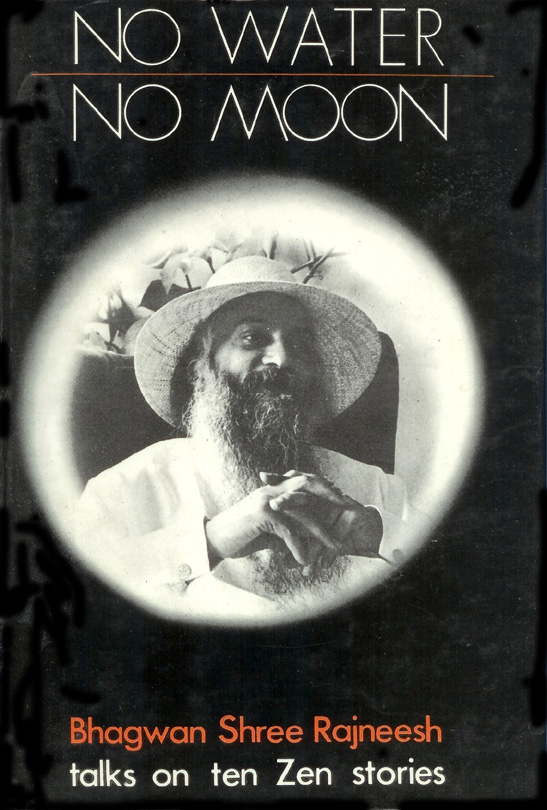
No Water, No Moon
Discourses
Table of Contents
No Water No Moon
No Water No Moon. The nun Chiyono carried a pail of water, watching the moon's reflection. The bamboo broke, the pail fell apart—no more water, no more moon—emptiness in her hand. She became enlightened. Enlightenment is always sudden—no gradual progress, because all gradualness belongs to mind. Mind can study about God but never know God. 'About' means missing—you must become it. Knowledge belongs to the ego; the ego is the periphery and can never reach the center. Love is known only when you become love. No more water, no more moon in the water—just emptiness.
Trading Dialogue for Lodging
Trading Dialogue for Lodging. A wandering monk debated the one-eyed younger brother in silence. One finger (Buddha) → two fingers (Buddha and teaching) → three fingers (Buddha, teaching, followers) → clenched fist (all one realization). But the younger brother saw: one finger (you have one eye) → two fingers (you have two) → three fingers (three between us) → fist (punch you). All debates are futile—you may get a night's shelter but must move on. Logic gives only a night's shelter, never truth. Half-truths don't exist—truth is the whole. Approximate truth is a deception. Don't make the shelter your home.
Is That So?
Is That So? Hakuin was accused of fathering a girl's child. 'Is that so?' He cared for the child, lost his reputation. A year later the truth came out. 'Is that so?' Real purity is innocence, not moral calculation. Your purity is a choice—God against Devil, good against bad—already divided. Innocence flowers when existence is undivided. The priest who calculated whether to help the dying man—that's morality, not purity. Purity doesn't choose; it accepts existence as it is. 'Is that so?'—the response of a man who doesn't judge, doesn't resist, simply accepts.
The Dead Man's Answer
The Dead Man's Answer. Mamiya was asked about the sound of one hand clapping. He fell over as if dead. 'You're dead all right—but how about that sound?' 'I haven't solved that yet.' 'Dead men don't speak. Get out!' The absurd is needed to bring you out of the mind—reasoning is the very trap you're in. Something irrational is needed. Tertullian: 'I believe because God is absurd.' Faith means the absurd—no reason, no proof, yet you jump. If you can make sense out of religion, you've missed. The master's devices are absurd—thinking misses them.
Gutei's Finger
Gutei's Finger. Gutei raised one finger whenever he taught Zen. A young disciple imitated him. Gutei cut off the boy's finger. As the boy ran off howling, Gutei shouted 'Stop!' and raised his own finger. The boy tried to raise his—realized it was gone—and became enlightened. Don't evaluate the enlightened through your values—they live without criteria, without morality. The master's action looks cruel but is compassion. The boy was imitating, not understanding. When the finger was gone, the understanding came. Enlightenment is not imitation—it's the direct experience of your own being.
Why Don't You Retire?
Why Don't You Retire? Tokusan asked many questions. 'The night is getting old—why don't you retire?' 'It's very dark outside.' Ryutan offered a candle, then blew it out. In that moment, Tokusan's mind opened. You cannot study Zen—it's not an object of study but a way of life. Nobody can teach it; you can only allow yourself to be infected by it. Living with the master is enough. The candle blown out: the light outside is useless—find the light within. All questions are in darkness; the answer is blowing out the question itself.
Black-Nosed Buddha
Black-Nosed Buddha. A nun carried a golden Buddha statue. She burned incense but funneled the smoke only to her statue—blackening its nose. Attachment looks like love but is its opposite. Love means merging, dissolving, surrender. Attachment means possessing, controlling. Even hate is better than attachment—hate is at least true. Attachment kills love. The nun's devotion to one statue blinded her to all other Buddhas. Possessiveness blackens the object of devotion. Love is ready to lose itself; attachment is afraid of losing.
The Giver Should Be Thankful
The Giver Should Be Thankful. The merchant Umezu donated 500 gold pieces. Seistsu said 'All right, I'll take it'—no thanks. 'That's a lot of money.' 'Do you want me to thank you?' 'The giver should be thankful.' Two ways to live: giving and sharing (love) or snatching and accumulating (money). Even when approaching Buddha, people approach through money—how much he renounced. The giver should be thankful: giving is a privilege, an opportunity to share. When you give, you receive more than you give. The ego wants thanks; the awakened heart gives out of overflow.
A Philosopher Asks Buddha
A Philosopher Asks Buddha. 'Without words, without the wordless, will you tell me the truth?' Buddha kept silent. The philosopher bowed: 'I have cleared away my delusions.' Ananda asked what he attained. 'A good horse runs even at the shadow of the whip.' Philosophy and religion are diametrically opposite—thinking vs. trust, doubt vs. faith. Head and heart are parallel lines—they never meet. You can jump from one to the other but there's no continuity. The philosopher was rare—he was humble enough to understand silence. A good horse needs no whip—just the shadow is enough.
Ninakawa Smiles
Ninakawa Smiles. Ikkyu visited the dying Ninakawa. 'Shall I lead you on?' 'I came alone, I go alone—what help could you be?' 'If you think you really come and go, that's your delusion.' Ninakawa smiled and passed away. Death is the crescendo of life. If you resist, you become unconscious—miss the opportunity. If you welcome it, you become perfectly conscious—enlightenment is possible. Death and enlightenment are similar. The body goes, the mind goes, the ego dissolves. If you've been preparing through meditation, death becomes the final jump. Yes to death makes you perfectly conscious; no makes you unconscious.