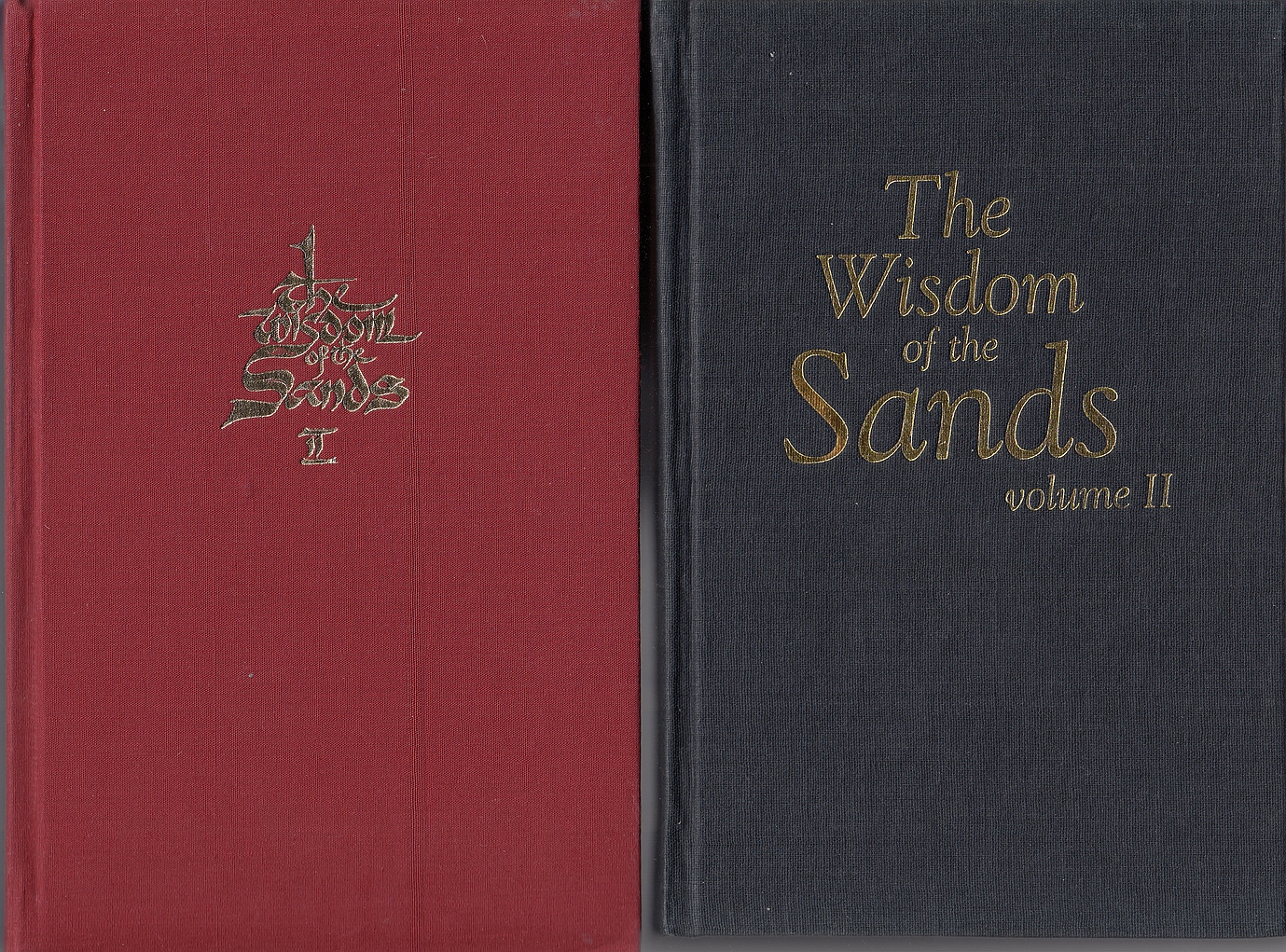
The Wisdom of the Sands, Vol 2
Discourses
Table of Contents
The Man with the Inexplicable Life
The Man with the Inexplicable Life. Mojud met Khidr, who told him to leave his job. 'Tear your clothes and throw yourself into the stream.' A fisherman saved him. Khidr appeared again: 'Leave this fisherman.' He worked for a farmer for two years. Khidr appeared again and again, each time sending him onward. Mojud became a great teacher. The man with the inexplicable life: the path is not planned—it unfolds step by step through surrender to the unknown.
Drop Becoming! Being is Enough
Drop Becoming! Being is Enough. 'I want to fight you—there's a hierarchy here.' Fighting the master is fighting yourself. 'Why is the mind?' Mind is practical—it screens out awareness but also helps do things. It has a place but must be transcended. Don't become its slave. Drop becoming! Being is enough: you are already what you seek to become. The mind can be a servant; when it becomes the master, you're lost.
You are here to be yourself
You are here to be yourself. 'Why are so many people against you?' It's natural—what Osho does shatters their minds, cuts their roots, offends their conditioning. The greatest offense: he says you are already that which you seek. No need to become—just be. People are against because their whole trip is becoming. You are here to be yourself: not to improve, not to become, but to drop all masks and be what you already are.
The Three Jewelled Rings
The Three Jewelled Rings. A rich man gave three sons each a ring—a key to a treasury. Each claimed primacy. They were so preoccupied with the rings that none looked for the door. The rings had a magical quality: looking upon them without contention revealed the treasury. Three communities: one thought they'd found the treasure, one thought it allegorical, one postponed it to the future. The three rings: religions fight over their keys while the treasury remains unopened.
Allow the Heart
Allow the Heart. 'Poets like Shakespeare and Bob Dylan—were they conscious of their glimpses?' The mystic lives in the other reality. The poet only has glimpses—doors open and close. He's possessed, says things he can't explain later. The poet is a channel, not a master. Allow the heart: the poet has moments of truth but no grounding. The mystic IS the truth. Don't compare poets with mystics—glimpses vs. permanent vision.
Jesus Christ, I Missed!
Jesus Christ, I Missed! 'If everyone is a mirror, where is uniqueness? Enlightenment is union.' To be unique, avoid enlightenment. A Buddha has disappeared—how can he be unique? Uniqueness implies separateness. The ego wants to be unique even in enlightenment. Jesus Christ, I missed: enlightenment is the death of the ego, the end of separateness. What remains is not unique—it is universal. The whole existence is your body now.
Thirsty
Thirsty. A king was thirsty. Lackeys brought oil, then pickles and vinegar, then scented syrups. His digestion was ruined. A wise man said: 'His Majesty needs ordinary water.' Thirsty: truth is simple—ordinary water. The mind seeks complexity, exoticism, sophistication. All the king's servants made it worse. The master says: drink ordinary water. The whole search is for the simple, the obvious, the ordinary. You are already thirsty and the water is here.
Easy is the Flow
Easy is the Flow. 'Am I a restless confused buddha?' You are a Buddha from the very beginning. Buddhahood is the source and the goal. The only question is recognition, not realization. Consciousness is engaged with objects—disengage it and let it fall within. Easy is the flow: turn in. The other keeps you occupied with toys. When consciousness falls within, recognition arises. You taste your being for the first time.
I am the Fire!
I am the Fire! 'Why should you be my master and I your disciple?' There is no reason. It is irrational, absurd—credo quia absurdum. To be with a master is a love affair. Have you ever asked why one falls in love? I am the fire: the master-disciple relationship is not rational. It is a love affair. No reason can be supplied because none exists. The mind wants reasons; the heart needs none.