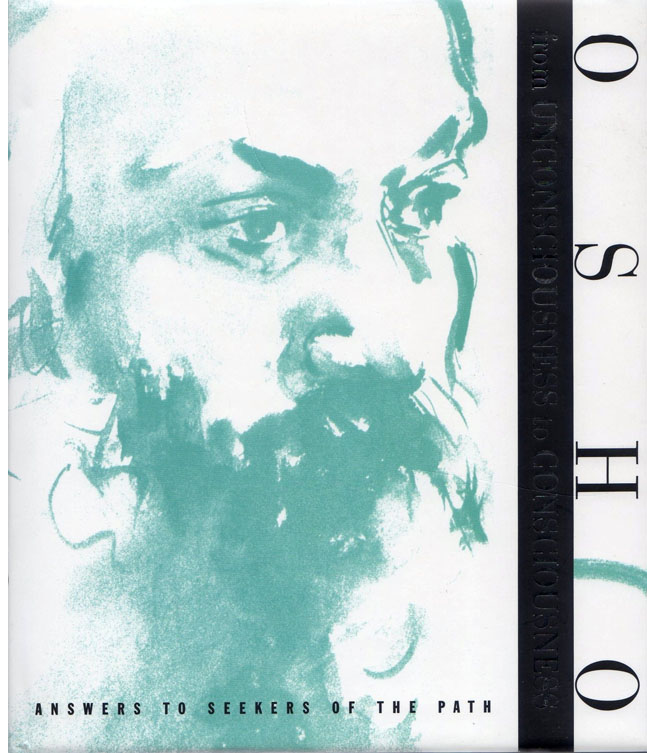
From Unconciousness to Consciousness
Discourses
Table of Contents
Silence, the Pull of the Innermost Zero
My religion is the first and the last—it needs no organization, no creed. After 1,315 days of silence, speaking again feels like learning ABC. Silence, the pull of the innermost zero: the world of words and silence never meet. I had answers but no questions. The professor thought I was crazy. The first and last religion: mysticism without belief, inquiry without conclusion.
Don't Follow Me -- Because I am Lost Myself
Jesus says 'Come follow me'—Krishna and Buddha said it too. It's psychological exploitation. Following cripples: you surrender your eyes, your legs, your self. You become phony, a hypocrite with a mask. Don't follow me—because I am lost myself. I say come and share me. Each individual is unique; following means imitating, losing identity. I am a friend, not a leader.
Godliness, but there is no God
There is no God, but I'm not an atheist. Atheists deny consciousness too—I don't. Godliness, but there is no God. God as person is projection: Chinese God has Chinese face, Negro God has Negro face, horses' God would be a horse. God is a quality, not a person—the fragrance of existence. I was called Bhagwan: not God, but godliness. The bullock cart analogy: consciousness is not a byproduct of assembled parts.
The Opium Called Religion
I am not a messiah—there has never been one. The idea needs a personal God who sends messengers. Caliph Omar tortured a man claiming to be God's messenger. The opium called religion: messiah, avatara, paigambara—all exploit your psychological need for hope. Mohammed is declared the last paigambara to stop competition. Religion is the oldest drug.
To be Rebellious is to be Religious
Messiahs, avataras, tirthankaras are disgusting company. Parasurama murdered his mother. To be rebellious is to be religious. Marriage is legalized prostitution—love become plastic. True lovers part gratefully when love fades. I am just an ordinary man; I refuse to be categorized as anything special. Rebellion is the essential religious quality—obedience is spiritual suicide.
The so-called holy books are just religious pornography
All religions are afraid of women because they're afraid of sex. Confucius said women have no soul—killing your wife wasn't a crime in China. The so-called holy books are just religious pornography. Religions repress sex because it's the greatest energy—repression needs no intelligence, only idiots do it. The more monks repress sexuality, the more stupid they become. Sex must be transformed, not repressed.
From Crossianity to Jonestown
Jonestown can't happen here—my philosophy is the opposite of Jim Jones'. Jones was a Christian priest; his roots are in Christianity, not in me. Christianity is Crossianity—based on crucifixion, not Christ. Jesus wanted crucifixion to prove his messiahhood. From Crossianity to Jonestown: fanatical faith breeds mass suicide. Faith that can't question 'why' is dangerous. My approach is doubt, inquiry, intelligence.
Will-to-power: The Cancer of the Soul
Will-to-power is the cancer of the soul. Politicians are basically impotent—their urge to power comes from feeling empty. Lord Acton: power corrupts, absolute power corrupts absolutely. The politician needs power to forget his nobodiness. Will-to-power: the cancer of the soul. It can express in politics (easiest), religion, business. I'm against the disease, not the person. The politician is psychologically sick.
Just to be Born is Not Enough to be Alive
Why do we lead a rich life? The real question is why we live at all. Life means abundance in every dimension. Just to be born is not enough to be alive. Millions die without ever having lived. Existence is rich—millions of flowers, stars expanding. Visitors who question our richness have never lived. Life is for love, joy, ecstasy. Vegetating is not living. We live richly because we live.
Your Childhood -- an Education in Psychological Slavery
Belief in a messiah is blind—based on psychological need, not proof. The messiah exploits your need: 'Just believe in me.' Your childhood—an education in psychological slavery. Trust in a master is different: it's not belief but a heart-to-heart communion. Belief covers your psychological vacuum; trust dissolves it. The messiah gives opium; the master gives awareness.
Yes, I Teach You Selfishness
Yes, I teach you selfishness. Selfishness is natural—without it, no child would survive. All religions teach service to others, but that makes hypocrites. First be selfish: take care of yourself. When your self dissolves into the universal, true unselfishness happens spontaneously. A person who hasn't taken care of himself has nothing to give. Selfishness is the foundation; unselfishness is the flowering.
Live Now, Pray Later
Three ways to live: in yesterday (dead), in tomorrow (never comes), and now (authentic). Religions put hope in future life—live now, pray later. The past and future are pseudo; only the present is real. Hope is the oldest psychological drug. Tomorrow is always coming but never arrives. Live now, and prayer arises from living, not from hoping. Prayer is gratitude for this moment, not a request for the next.
Ready-to-wear Religion at the Secondhand Store
Ready-to-wear religion at the secondhand store: every child is indoctrinated before he can question. Answers are given before questions arise—killing the possibility of genuine inquiry. You cannot discover religion as a Christian or Hindu—those are preventions. To be religious, drop all previous ideas. Religion is not inherited or borrowed; it's your own discovery. Clean your consciousness of all writing.
I am a gnostic
I am a gnostic—not a category of belief. The theist believes without knowing; the atheist denies without knowing. The agnostic says 'I don't know'—but stops there. The gnostic says 'I don't know' and enquires until knowing happens. Belief is escape from doubt; gnosis is going through doubt. The believer is schizophrenic—belief on surface, doubt underneath. The gnostic is whole—doubt dissolved through knowing.
The Priest and the Politician -- the Mafia of the Soul
The priest and the politician—the mafia of the soul. Religions taught God is all-powerful, looking after the world—so man need do nothing. This prevented man from improving life. Don't throw responsibility onto a nonexistent God. We are responsible. The priest exploits your fear, the politician exploits your hope. Together they enslave humanity. The world is sick because these two have poisoned it for millennia.
God Is the Greatest Fiction Ever
God is the greatest fiction ever. One lie needs a thousand more to protect it—God is the basic lie. The devil seducing Eve is a supporting lie. The full story: Adam had a first wife, Lilith, who was banished. Then Eve was created from Adam's rib. The devil is needed to explain evil—because if God is all-good and all-powerful, where does evil come from? The devil is God's alibi. Truth needs no protection.
The Immaculate Deception
No holy books exist—all books are human. Hindus say Vedas are the only holy books, but internal proofs show human authorship: a brahmin praying for more milk than his neighbors. The immaculate deception: every religion claims its book is God's word. The devil was invented to protect God's goodness—if God created everything, he created evil too. The devil is the scapegoat for God's failures. Holy books are human, not divine.
Marriage -- the Coffin of Love
Marriage—the coffin of love. The master-disciple relationship is unique because it's not a relationship at all. Father-son is static; lover-beloved is fragile, unpredictable. Marriage kills love by making it legal, static. My relationship with you is not static—it's a living communion, changing every moment. The master-disciple connection is closer to lovers than to father-son: fragile, alive, unpredictable. Marriage is the coffin; love is the life.
Meditation -- the Science of Awareness
Science discovers, art invents, religion does both. True religion discovers; pseudo-religion invents. Art served pseudo-religion for centuries—beautiful churches, temples. Meditation—the science of awareness. Religion is not fiction but discovery, like science. The difference: science discovers the objective, religion discovers the subjective. Both use the same method: doubt, experiment, experience. Meditation is the laboratory; consciousness is the subject.
You Cannot Manufacture Enlightenment
I am not even a primary school teacher, let alone world teacher. Indian philosophers claimed to be world teachers by winning debates—intellectual conquest, not spiritual. You cannot manufacture enlightenment. Enlightenment is not a product of debate, logic, or scripture. The world teacher idea is ego. I teach nothing—I only remove barriers. Enlightenment happens when you stop manufacturing. It's already there—just remove the obstructions.
Enlightenment -- The Only Way Home
Enlightenment is the most simple, natural phenomenon—that's why it's so difficult. Mind is attracted to the difficult: climbing Everest, going to the moon. Enlightenment—the only way home. It has not evolved with time; it's the same discovery. It's not an achievement but a recognition. You are already home but don't know it. Enlightenment is simplicity itself: just being, without any doing. The simplest thing is the hardest for the mind.
Theology -- The Jungle of Lies
Existence has no meaning and is not meaningless—meaning is irrelevant. The mind brings the problem of meaning. Theology—the jungle of lies. The ocean sinking a ship is neither moral nor immoral—it's amoral. Existence is amoral. Man invented God to find meaning, but existence needs no meaning. It simply is. Theology is lies protecting the basic lie of God. Drop meaning and you find existence overflowing with isness.
The Only Way to Fail Me is Not to Be Yourself
It's impossible to fail me—I've given no commandments. You can fail Moses by breaking commandments, fail Jesus by not being superhuman. I've given you no superhuman ideals. The only way to fail me is not to be yourself. I've not persuaded you to go beyond ordinariness—just to be ordinary, natural. You can't fail because there's nothing to fail. Be yourself and you've succeeded. Don't be yourself and you've failed.
The Psychology of Being -- The Golden Key
The mind is the most complex phenomenon in existence. The psychology of being—the golden key. Three doors of mind: instinctive (animal), intellectual (human), intuitive (buddha). Mind in religion: mind is the barrier, not the bridge. But you must understand the barrier to go beyond it. Psychology studies the mind; meditation goes beyond it. The golden key: awareness that watches the mind without becoming it.
I Am Against Religions, but I Am For Religion
I am against religions, but I am for religion. Religion means putting parts together so the part becomes whole. With no God, no devil, what is religion about? It's about wholeness—bringing your fragmented being into unity. A sannyasin doesn't need a religion (organization)—he needs religiousness (quality). Religion is not belief in God; it's the experience of wholeness. The part separate is dead; joined, a new quality appears.
Your Actions Are not My Concern -- Your Consciousness Is
Sin is a technique of pseudo-religions—creating guilt to enslave. Your actions are not my concern—your consciousness is. Sin makes you dependent on messiah, priest, God. Once guilty, you're imprisoned. I don't talk about sin; I talk about unawareness. The only sin is unconsciousness; the only virtue is awareness. Don't feel guilty about actions—become more conscious. Consciousness transforms actions naturally; guilt only represses them.
Religion -- The Last Luxury
Religion—the last luxury. It comes only when physical and psychological needs are fulfilled. Blessed are the rich, not the poor. The poor can't afford religion—they need bread first. That's why Eastern religions flowered: Eastern societies had reached luxury. Religion is the ultimate luxury: you explore consciousness when survival is handled. I'm against all religions (organizations) but for religion (inquiry). Truth is one; lies are many. Religion is discovery, not invention.
Commandments, No -- Just a Few Requests
Moses was a charismatic leader, not a religious man. He was a lawgiver—laws are dead, consciousness is living. Commandments, no—just a few requests. Laws don't change with context; consciousness does. Moses gave commandments because he couldn't give consciousness. Right and wrong are not eternal—they change with time, context, culture. I give requests, not commandments: suggestions for conscious living, not fixed rules. Consciousness is the only real law.
I Teach You Reverence For Life
Completing the list to ten requests. Religions give superhuman ideals—they satisfy the ego but frustrate the being. A rose can't become a lotus. I teach you reverence for life: accept your humanness. Don't try to be superhuman—be totally human. Reverence for life means respecting your nature, your body, your instincts. Transform them through awareness, don't condemn them. The sixth request: don't try to become—just be.
The Only Golden Rule is There are No Golden Rules
The only golden rule is there are no golden rules. Life is too vast to be reduced to rules or maxims. Live dangerously: people who remember maxims forget life. Living itself is so intense I forget rules. The golden rule: there are no golden rules. Life is mysterious, immense, alive—rules kill it. Don't follow rules—follow life. Live dangerously: risk, explore, don't play safe. Safety is the only real danger.